The Bluetti EP500 Pro review reveals a serious contender in the stationary home backup category, blurring the line between a massive portable power station and a permanent residential energy storage system. With a 5100Wh LiFePO4 battery, continuous 3000W pure sine wave output, and the ability to pair two units for split-phase 240V power, this Bluetti EP500 Pro targets homeowners who want grid independence without the complexity or cost of a Tesla Powerwall installation.
How this review was produced: we do not buy or test the products we cover. This is a desk analysis of manufacturer specifications, manuals and documentation, safety and certification listings, and publicly available owner reports and third-party reviews. Figures are manufacturer claims or reported owner results.
The product card below is a separate Amazon listing for the BLUETTI Elite 300 (3014.4Wh), a smaller BLUETTI home-backup station, not the 5100Wh EP500 Pro reviewed here.
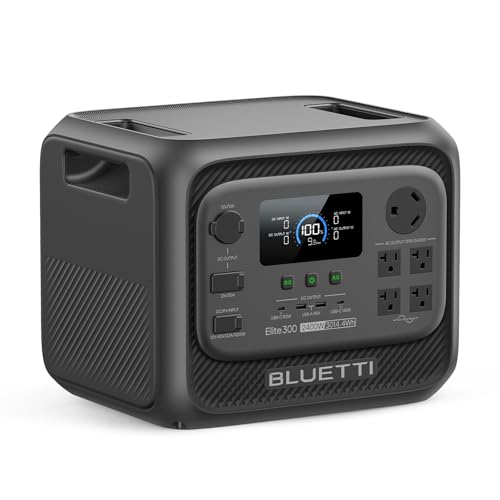
Bluetti EP500 Pro Overview: Home Battery Competitor
The EP500 Pro sits at the top of Bluetti’s stationary lineup. Unlike the AC200MAX or AC300 which lean portable, this unit weighs 182 pounds and ships on a pallet. It is built around a 5100Wh lithium iron phosphate battery rated for 3500 cycles to 80% capacity. That chemistry choice matters. LiFePO4 cells tolerate deeper discharges, higher charge rates, and wider temperature swings than NMC alternatives. For a device marketed as a decade-long home backup asset, the cycle life rating is the single most important specification on the sheet.
The form factor is a vertical tower measuring 20.5 x 12.6 x 29.7 inches. Four recessed caster wheels and a telescoping handle allow one strong person to move it across a garage floor or concrete patio. Do not mistake this for camping portability. If your use case involves frequent relocation between a van, cabin, and job site, the smaller AC300 with external B300 batteries makes more sense. The EP500 Pro is a semi-permanent installation that can be relocated when necessary.
A 4.3 inch color touchscreen shows real-time input, output, state of charge, and cell voltage. Physical buttons handle power on/off, AC enable, and DC enable. Ports are grouped logically: four 120V AC outlets (NEMA 5-20R), one 30A RV port (TT-30R), two USB-A, two USB-C 100W PD, one 12V/10A car port, and two 12V/30A aviation ports for high-draw DC loads. The rear houses the PV input (150V/12A max per channel, dual MPPT), AC charging inlet, and the parallel communication port for linking a second unit.
5100Wh LFP Battery and Real-World Capacity
The 5100Wh capacity translates to roughly 4.6 kWh usable at 90% depth of discharge.
Cycle life is where the LiFePO4 chemistry pays off. Bluetti rates the EP500 Pro for 3500 cycles to 80% capacity. At one full cycle per day, that is nine and a half years. At a more realistic three cycles per week during outage season plus occasional top-offs, you are looking at 15 to 20 years of service. The 5-year warranty (extendable to 6 years with registration) covers defects and capacity drops below 60% during the warranty period. Compare that to the Tesla Powerwall 2 warranty of 10 years at 70% capacity retention. The Powerwall uses NMC chemistry with a different degradation curve, but the EP500 Pro’s LFP cells are inherently more stable at high temperatures, which matters in unconditioned garages.
Thermal management uses internal fans that spin up only when cell temperature exceeds 40°C or inverter load passes 2000W. The operating range is -20°C to 40°C for discharge and 0°C to 40°C for charge.
Smart Home Integration and App Control
The Bluetti App connects via Bluetooth for local control and Wi-Fi for cloud monitoring. The dashboard shows real-time watts in/out, SOC percentage, estimated runtime, and per-port status. You can schedule AC charging windows to take advantage of time-of-use rates, set a minimum SOC reserve for outage readiness, and toggle eco mode which shuts off the inverter after 4 hours of no load.
Smart home integration works through the Bluetti Skill for Alexa and Google Home. Voice commands can turn AC output on/off, check battery level, and trigger scenes. The UPS switchover time is rated at 0ms for the EPS (emergency power supply) outlets and 20ms for standard outlets. For critical medical devices, use the EPS outlets or add a dedicated line-interactive UPS downstream.
Firmware updates arrive over Wi-Fi.
Continuous 3000W Output Performance
The inverter is rated 3000W continuous, 6000W peak for 10 seconds. Factor that into runtime calculations.
Typical whole-home essential load profiles:
| Load Profile | Total Watts | Notes |
|---|---|---|
| Fridge + LED lights + router + phone charging | 220W | Overnight essential |
| Above + 1500W space heater (cycling 50%) | 970W avg | Winter morning |
| Well pump (900W) + fridge + lights | 1100W avg | Intermittent pump cycles |
| Full essential panel (12 circuits via transfer switch) | 1800W avg | Includes microwave bursts |
For multi-day outages, solar recharge is mandatory. The dual MPPT controllers accept up to 2400W combined (150V/12A each). Plan your solar array at 2000W or higher if daily energy independence is the goal.
Bluetti EP500 Pro vs EcoFlow DELTA Pro Ultra Comparison
The direct competitor in the Bluetti EP500 Pro review space is the EcoFlow DELTA Pro Ultra. Both target the same whole-home backup buyer. Here is how they stack up on the metrics that matter.
| Spec | Bluetti EP500 Pro | EcoFlow DELTA Pro Ultra |
|---|---|---|
| Battery Chemistry | LiFePO4 | LFP (LiFePO4) |
| Base Capacity | 5100Wh | 6000Wh (single unit) |
| Continuous Output | 3000W | 3600W (7200W surge) |
| Max Solar Input | 2400W | 5600W (with extra MPPT) |
| 240V Split-Phase | Yes, pair two units | Yes, single unit with Smart Home Panel 2 |
| Expandability | B500 modules (4960Wh each) | Extra batteries up to 90kWh |
| Weight | 182 lbs | 183 lbs (base unit) |
| Warranty | 5 years (6 registered) | 5 years |
The EcoFlow wins on raw specs: more capacity, higher output, faster solar charging, and a more mature ecosystem (Smart Home Panel 2, EV charging integration, generator auto-start). The Bluetti wins on value per kWh and simpler pairing for 240V (just a communication cable, no external panel required). If you already own Bluetti gear (B300, B230, PV200 panels), the EP500 Pro integrates natively. If you are starting fresh and want maximum solar harvest with minimal roof space, the DELTA Pro Ultra’s 5600W input is compelling.
One practical difference: the EP500 Pro’s parallel cable is a proprietary 2-meter link. The DELTA Pro Ultra requires the Smart Home Panel 2 for whole-home 240V transfer. That panel adds cost but provides code-compliant grid isolation, automatic transfer, and circuit-level monitoring. The Bluetti approach is DIY-friendly and requires a manual transfer switch or generator interlock wired by a licensed electrician.
240V Split-Phase Capability and Whole-Home Setup
The Bluetti EP500 Pro review demonstrates that pairing two units for 240V split-phase operation is straightforward in theory but requires careful electrical design in practice. Connect the units via the rear parallel communication port, and the BMS synchronizes DC-to-AC conversion so that one unit handles the positive phase and the other the negative phase. The result: 6000W continuous output at 240V, enough to power a central air conditioner, electric range, or whole-home load.
The catch: you need a licensed electrician to wire a manual transfer switch or generator interlock rated for 240V switching. Most inspectors expect a listed product or a signed engineering letter. At approximately $500 to $1500 in electrical labor, plus the transfer switch itself, the total 240V system cost (two EP500 Pro units + switch + labor) before solar is still less than the Tesla Powerwall 2 with Backup Gateway 2, but you sacrifice turnkey installation and app-based automatic switching.
For off-grid cabins and homesteads, this flexibility is an asset. You control the installation timeline, choose your transfer method (manual, generator-interlock, or hybrid-ready with future grid-forming capability), and avoid vendor lock-in. For suburban grid-tied homes seeking plug-and-play resilience, the Powerwall’s integrated solution is worth the premium.
Solar Charging Speed and Expandability
The dual MPPT solar charge controllers on the EP500 Pro accept 2400W combined input, slightly above the unit’s 3000W continuous AC output. That creates an interesting design choice: you can recharge faster than you discharge if solar is abundant.
Charging speeds from depleted to full with various array sizes:
- 2400W array (estimated): 2.8 to 3.2 hours, solar dependent
- AC charging from wall: 9 hours at 30A circuit, 5 hours at 48A (hardwired)
- Vehicle charging: 12 hours via standard 120V outlet, 6 hours via 240V dryer outlet
Expandability via the B500 modules adds 4960Wh per battery in 5-unit parallel stacks. The first B500 adds capacity less efficiently than the base 5100Wh unit. Practical expansions are one to two B500 units, bringing total system capacity to 10kWh or 15kWh. Beyond that, a second full EP500 Pro unit makes more economic sense, especially if you plan to implement 240V split-phase operation.
Noise and Placement
For bedroom backup systems or quiet office environments, you may want to locate the unit in a separate room or build acoustic dampening around it. The fan runs on a thermal algorithm, not a simple thermostat.
Practical Setup: Off-Grid Home Installation
For van lifers and off-grid homeowners, here is what a realistic installation looks like: One EP500 Pro unit, 2400W of solar panels, a subpanel or manual transfer switch, breaker and wiring ($200 to $500), and 4 to 8 hours of labor from an electrician ($600 to $1600). Together, that is a single-phase off-grid power source with nightly charging and daytime load priority.
For whole-home 240V backup, add a second EP500 Pro, a double-throw transfer switch rated for generator service, a parallel communication cable, and 8 to 12 hours of electrical labor ($1,200 to $2,400). Together, that is a redundant backup system.
Both setups are substantially cheaper than a Tesla Powerwall 2 (two units required for 240V, $22,000 to $25,000 installed), the LG Chem RESU Prime (a single 9.8kWh unit, still requires hybrid inverter and electrical design), or a full off-grid diesel genset backup ($15,000 to $25,000 plus ongoing fuel and maintenance).
Drawbacks and Limitations
The Bluetti EP500 Pro review would be incomplete without addressing gaps:
- Manual 240V switching: No automatic transfer switch included. You wire a generator-style manual switch or interlock, adding cost and complexity. EcoFlow’s Smart Home Panel 2 automates this at additional cost.
- Limited solar input: The 2400W maximum lags competitors. If you have multiple large arrays, you will need external charge controllers or a second unit.
- No EV charging integration: Unlike the EcoFlow, the EP500 Pro cannot natively manage vehicle charging or prioritize grid export. You need external EV chargers with their own logic.
- Expansion cost: B500 modules are more expensive than buying a second full EP500 Pro unit. Scalability is awkward at the 10kWh to 20kWh range.
- Warranty coverage: The 5-year base warranty (6 years registered) is shorter than Tesla’s 10-year standard. If your system fails on day six years plus one day, you own the battery replacement.
FAQ: Common Questions About the Bluetti EP500 Pro
Can the EP500 Pro run an air conditioner?
No, not alone. A single unit maxes out at 3000W continuous output. Central AC compressors draw 3500W to 5000W on startup. A single unit will trip its breaker. However, two units paired for 240V split-phase operation can sustain 6000W continuous, enough for most 3-ton to 4-ton air conditioners. You will deplete a dual-unit system in roughly 1 to 2 hours, so AC is a short-term emergency load, not all-day operation without solar recharge.
How long does the EP500 Pro battery last?
Bluetti rates the EP500 Pro for 3500 full charge cycles to 80% remaining capacity. At one cycle per day, that is 9.5 years. At three cycles per week plus top-offs, 15 to 20 years is realistic.
