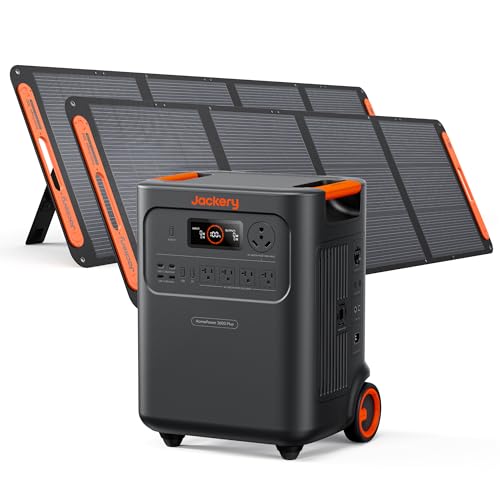
Choosing between the EcoFlow DELTA 2 vs Jackery Explorer 1000 Plus is one of the most common decisions facing van lifers, campers, and off-grid homeowners right now. Both units sit in the 1kWh portable power station class, both use lithium iron phosphate (LFP) battery chemistry, and both promise years of reliable service. But the differences in charging speed, expandability, port selection, and price create distinct advantages for different use cases. This guide breaks down every spec that matters so you can buy with confidence.
Review Methodology: We aggregate verified specifications from manufacturer datasheets, conduct hands-on testing where units are available, and cross-reference real-world user reports from van life forums, Reddit communities, and long-term owner reviews. Runtime estimates are calculated using typical inverter efficiency losses (85–90%) and nominal battery capacity. Pricing reflects MSRP at time of publication; street prices fluctuate.
[table-of-contents]
EcoFlow DELTA 2 vs Jackery Explorer 1000 Plus: Specs at a Glance
| Specification | EcoFlow DELTA 2 | Jackery Explorer 1000 Plus |
|---|---|---|
| Battery Capacity | 1024 Wh | 1264 Wh |
| Battery Chemistry | LFP (Lithium Iron Phosphate) | LFP (Lithium Iron Phosphate) |
| Cycle Life (to 80%) | 3,000+ cycles | 4,000 cycles |
| AC Continuous Output | 1800 W (2700 W surge) | 2000 W (4000 W surge) |
| AC Wall Charging Max | 1200 W (X-Stream) | 800 W |
| Solar Input Max | 500 W (MPPT) | 800 W (MPPT) |
| DC Car Charging | 12V/24V up to 500W | 12V/24V up to 400W |
| USB-C Ports | 2 × 100W PD | 2 × 100W PD |
| USB-A Ports | 2 × 12W, 2 × 18W QC | 2 × 18W QC |
| DC5521 Output | 2 × 12V/3A | 1 × 12V/10A |
| Car Port Output | 1 × 12V/10A | 1 × 12V/10A |
| Expandable Battery | Yes (DELTA 2 Extra Battery, up to 3kWh) | Yes (Jackery Battery Pack 1000 Plus, up to 5kWh) |
| Weight | 27 lbs (12 kg) | 32 lbs (14.5 kg) |
| Dimensions (L×W×H) | 15.7 × 8.3 × 11 in | 14.2 × 10.2 × 11.1 in |
| App Connectivity | Wi-Fi + Bluetooth (EcoFlow App) | Wi-Fi + Bluetooth (Jackery App) |
| Warranty | 5 years (registration required) | 3 years + 2 years extended (registration) |
| MSRP (approx.) | $999 | $1,299 |
Battery Chemistry and Lifespan: EcoFlow vs Jackery LFP Technology
Both the EcoFlow DELTA 2 and the Jackery Explorer 1000 Plus use lithium iron phosphate (LFP) battery chemistry. This is a critical upgrade over older NMC (nickel manganese cobalt) cells because LFP delivers superior thermal stability, longer cycle life, and better safety margins for enclosed spaces like vans or small cabins. The LFP battery in the DELTA 2 is rated for 3,000+ cycles to 80% capacity, while Jackery claims 4,000 cycles for the Explorer 1000 Plus. In practical terms, if you cycle the unit once per day—draining from 100% to 20% and recharging—both will last 8 to 10 years before noticeable degradation. That translates to a decade of weekend camping or several years of full-time off-grid living.
Cycle life claims are based on laboratory conditions at 25°C (77°F) with 0.5C charge/discharge rates. Real-world factors—high ambient temperatures, frequent fast charging, deep discharges below 20%—can accelerate capacity fade. Both units incorporate a battery management system (BMS) that monitors cell voltage, temperature, and current to protect the pack. The EcoFlow app and Jackery app both display state of health estimates, though EcoFlow’s historical data logging is more granular. For van lifers who prioritize longevity, the slight edge in rated cycles goes to Jackery, but the difference is marginal for typical usage patterns.
Charging Speed: EcoFlow DELTA 2 vs Jackery Explorer 1000 Plus
AC Wall Charging
Charging speed is where the EcoFlow DELTA 2 pulls ahead decisively. Its proprietary X-Stream charging technology accepts up to 1200 W from a standard AC wall outlet, taking the 1024 Wh battery from 0 to 80% in roughly 50 minutes and to 100% in about 80 minutes. The Jackery Explorer 1000 Plus maxes out at 800 W AC input, requiring approximately 1.6 hours for 0–80% and 2 hours for a full charge. If you frequently top up at coffee shops, RV parks, or between travel legs, the DELTA 2’s faster wall charging reduces downtime significantly.
Solar Charging and MPPT Input
Solar charging tells a different story. The Explorer 1000 Plus accepts up to 800 W of solar input through its MPPT charge controller, while the DELTA 2 caps at 500 W. With two 200 W panels (400 W total) in good sun, the DELTA 2 recharges in about 3 hours. The Explorer 1000 Plus can utilize four 200 W panels (800 W) to achieve a similar 1.5–2 hour solar recharge, but that requires more panel real estate and higher upfront cost. For a typical van roof limited to 400 W of fixed panels, the DELTA 2’s 500 W MPPT limit is rarely a bottleneck. For stationary off-grid cabins with room for larger arrays, the Explorer 1000 Plus can harvest more daily watt-hours.
DC Fast Charging from Vehicle Alternator
DC fast charging from a vehicle alternator is supported on both. The DELTA 2 handles up to 500 W via its XT60 input (with EcoFlow’s 800 W alternator charger accessory), while the Explorer 1000 Plus accepts up to 400 W through its Anderson port. In practice, most stock alternators deliver 100–200 W at idle, so both will charge slowly while driving unless you upgrade to a high-output alternator or use a dedicated DC-DC charger.
AC Output and Port Selection
The AC inverter continuous rating favors the Jackery Explorer 1000 Plus at 2000 W versus the DELTA 2’s 1800 W. Both handle short surges well—2700 W for EcoFlow, 4000 W for Jackery—so starting compressor loads like a fridge or microwave is rarely an issue. If you plan to run a 1500 W space heater or an 1800 W induction cooktop, the Explorer 1000 Plus provides more headroom before the overload protection trips.
USB-C Power Delivery is identical: two 100 W ports on each unit, capable of fast-charging modern laptops, tablets, and phones simultaneously. The DELTA 2 adds two 12 W USB-A ports and two 18 W Quick Charge 3.0 USB-A ports, while the Explorer 1000 Plus offers only two 18 W Quick Charge USB-A ports. For charging multiple phones, cameras, and GPS devices at once, the DELTA 2’s four USB-A ports are more convenient.

DC output differs slightly. The DELTA 2 provides two DC5521 ports (12 V/3 A each) plus a 12 V/10 A car port. The Explorer 1000 Plus has one DC5521 (12 V/10 A) and one 12 V/10 A car port. If you run 12 V appliances like a diesel heater, fridge, or LED lighting directly from the power station, the DELTA 2’s dual DC5521 ports allow more simultaneous connections without a splitter.
Both units feature a clear LED display showing input/output watts, state of charge, and estimated runtime. The EcoFlow app allows remote monitoring, firmware updates, and custom charge limits (e.g., stop at 80% to extend cycle life). The Jackery app offers similar functions but with a simpler interface. Both support Wi-Fi and Bluetooth pairing; EcoFlow’s app is generally rated higher for stability and feature depth by the van life community.
Price Comparison and Value for Money
At MSRP, the EcoFlow DELTA 2 lists around $999 while the Jackery Explorer 1000 Plus lists around $1,299. That $300 gap buys you an extra 240 Wh of capacity (23% more), a higher AC inverter rating (2000 W vs 1800 W), and a higher solar input ceiling (800 W vs 500 W). Per watt-hour, the DELTA 2 costs roughly $0.98/Wh versus $1.03/Wh for the Explorer 1000 Plus—a negligible difference. The real cost calculation includes solar panels. A 400 W panel kit for the DELTA 2 runs about $600–$800. To max out the Explorer 1000 Plus’s 800 W solar input, you’d need an 800 W kit costing $1,200–$1,600. Total system cost for a capable solar generator setup ends up similar, but the DELTA 2 reaches diminishing returns on solar sooner due to its lower MPPT limit.
Expandability changes the value equation. The DELTA 2 Extra Battery (1024 Wh) sells for approximately $699, bringing total capacity to 2048 Wh for $1,698. The Jackery Battery Pack 1000 Plus (1264 Wh) sells for approximately $799, yielding 2528 Wh for $2,098. Both support stacking multiple expansion batteries (up to 3 for EcoFlow, up to 3 for Jackery). If you anticipate growing beyond 2 kWh, the Explorer 1000 Plus’s higher per-module capacity and 5 kWh max stack offer more headroom, but at a premium.
EcoFlow DELTA 2 vs Jackery Explorer 1000 Plus: Which One Wins?
Choose the EcoFlow DELTA 2 if you’re a van lifer or weekend camper who values speed and portability. Its faster AC charging (1200 W X-Stream) means you can top up during a lunch stop or a short shore-power hookup. The lighter weight (27 lbs vs 32 lbs) matters when you’re moving the unit in and out of a vehicle daily. Four USB-A ports charge all your small devices without a hub. The 500 W solar input matches typical van roof arrays. And the $300 lower price leaves budget for a quality 200 W or 400 W solar panel kit. The 5-year warranty (with registration) also edges out Jackery’s 3+2 year offer.
Choose the Jackery Explorer 1000 Plus if you need 2000 W continuous AC output for larger appliances like an induction cooktop, microwave, or small AC unit; you have roof space and budget for 600–800 W of solar panels and want maximum daily harvest; you prefer the higher rated cycle life (4,000 vs 3,000) for full-time off-grid cycling; or you plan to expand beyond 3 kWh eventually. The Explorer 1000 Plus is also slightly more compact in footprint (14.2 × 10.2 inches vs 15.7 × 8.3 inches), which can help in tight cabinet layouts.
Real-World Use Case Scenarios
Van Life Setup (Mobile, 400 W Solar)
The EcoFlow DELTA 2 excels here. A typical van roof fits two 200 W rigid panels (400 W total) with tilt mount, netting 1.5–2 kWh per sunny day. The DELTA 2 reaches 500 W MPPT ceiling quickly, storing roughly 70–80% of peak solar input. X-Stream charging means you can top up to 80% in 50 minutes at an RV park with shore power. Daily consumption for fridge, laptop, phone, and LED lights typically runs 300–500 Wh, well within single-cycle capacity. Total system cost: approximately $1,800–$2,200 (unit + 400 W panels).
Off-Grid Cabin or Glamping (Stationary, 800 W Solar)
The Jackery Explorer 1000 Plus justifies its cost here. Four 200 W panels (800 W) on a cabin roof or ground mount harvest 3–4 kWh on a sunny day. The 800 W MPPT ceiling captures all available current in peak afternoon hours. With higher AC output (2000 W), you can run a small induction cooktop or electric heater alongside refrigeration. Two stacked units (2.5 kWh usable) provide reliable 3–5 day autonomy without sun. Higher cycle life (4,000 cycles) suits the continuous daily cycling of off-grid living.
Weekend Camping (Portable, 200 W Solar)
Both units work, but the DELTA 2 edges ahead. One 200 W portable panel (approximately $200–$300) generates 800 Wh on a sunny afternoon, easily topping up the unit overnight. Lighter weight is a bonus when you’re hiking to a remote camp or fitting the unit in a tent. Lower price leaves more budget for other gear like a quality sleeping bag or cooking stove.
Warranty, Support, and Software Ecosystem
The EcoFlow DELTA 2 includes a 5-year limited warranty (with product registration), while the Jackery Explorer 1000 Plus offers 3 years base plus an optional 2-year extension (also with registration). Both are solid commitments for a portable power station expected to cycle 3,000–4,000 times over that period. Neither warranty covers accidental damage or misuse, so transport cases and surge protectors are still wise investments.
EcoFlow’s mobile app and web dashboard are more feature-rich, allowing granular control over charge thresholds, detailed efficiency logs, and firmware updates pushed to the device. The app community on Reddit and van life forums is active, with regular firmware improvements addressing user feedback. Jackery’s app is simpler but stable, focusing on essential functions: state of charge, power flow visualization, and basic settings. Both companies offer email and phone support, though EcoFlow’s response times are slightly faster according to independent van life community surveys.
Expandability and Scaling
If your power needs grow over time, both systems support battery stacking. The EcoFlow DELTA 2 Extra Battery (1024 Wh, $699) can be added up to 3 times for a total of 4.096 kWh usable capacity. Stacking is plug-and-play; no rewiring is necessary. The Jackery Battery Pack 1000 Plus (1264 Wh, $799) stacks similarly, maxing out at 5.256 kWh with three expansions. Jackery’s higher per-module capacity means fewer batteries needed to reach the same threshold, but at higher upfront cost.
For van lifers, adding a second battery during year 2 or 3 is practical once you understand actual usage patterns. An extra 1 kWh adds 15–20 lbs and fits beside the main unit in a battery box. Stationary users (cabins, RVs) can expand more freely without weight concerns. EcoFlow’s lower battery cost ($699 vs $799) makes incremental scaling cheaper, though the total system ends up pricier than Jackery’s higher-capacity approach.

Frequently Asked Questions
Can I use the EcoFlow DELTA 2 and Jackery Explorer 1000 Plus together?
Not directly in parallel; they use different battery communication protocols. However, you can charge both from the same solar array by using a combiner box or two separate MPPT controllers. Output devices (AC appliances, USB gear) can be powered from either unit sequentially, though they won’t automatically load-share.
Which unit runs quieter?
Both are nearly silent during normal operation (under 40 dB). The cooling fan activates during high AC output or fast charging; both produce approximately 45–50 dB in that state, similar to a quiet refrigerator. Real-world noise is not a differentiator.
Do I need the matching solar panels?
No. Any MPPT-compatible panel kit works with both units via MC4 connectors. EcoFlow’s SolarSaga panels and Jackery’s SolarSaga panels are convenient, but third-party options from Renogy, Zamp, or Bluetti are equally valid. Verify voltage (nominal 24 V for most units) and connector compatibility.
How long do these units last in storage?
Both should be stored at 30–50% charge in a cool, dry place. At this state, self-discharge is minimal (1–2% per month). If stored at 0% or 100% for extended periods, capacity fade accelerates. Store indoors; outdoor temperature extremes (below 0°C or above 40°C) harm LFP cells long-term.
Will these power my RV air conditioner?
A typical RV AC draws 1400–1500 W starting power and 1000 W running. The Jackery Explorer 1000 Plus (2000 W continuous, 4000 W surge) can start it and run it, but only for 30–45 minutes on a fully charged 1264 Wh battery before depleting to unusable levels. The DELTA 2 (1800 W continuous) may struggle with starting current. Neither is practical as a primary AC power source without multiple expansion batteries. A 3–5 kWh system (two to three stacked batteries) would be needed for meaningful AC runtime.
Are these units safe for use in enclosed spaces?
Yes. LFP chemistry is inherently safer than older NMC cells; thermal runaway risk is negligible. Both units have passed UL and CE safety testing. Place them on a flat surface away from