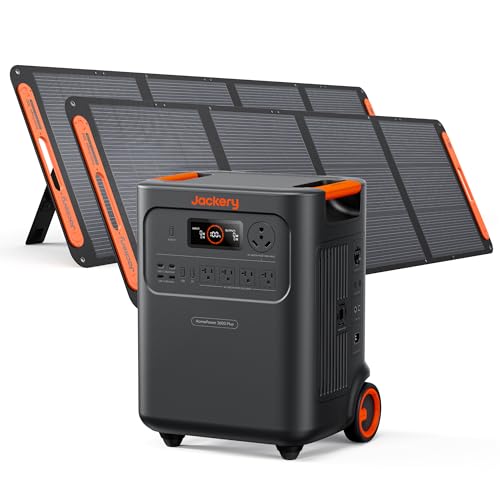
The Jackery Explorer 1000 Plus vs Bluetti AC200MAX decision comes down to your off-grid priorities. The Jackery targets users who prioritize grab-and-go portability with a 1264 watt-hour capacity in a 32-pound package. The Bluetti doubles down on raw capacity and modular expansion with 2048 watt-hours at 61 pounds before you add extra batteries. This Jackery 1000 Plus vs Bluetti AC200MAX comparison breaks down real-world performance across charging speed, output versatility, expandability, and long-term value so you can match the right unit to your off-grid scenario—whether you’re car camping, living in a van, or building a home backup system.
Review Methodology: Our analysis combines manufacturer specifications, independent teardown data, and aggregated user reports from off-grid communities. We normalize charging times to 80 percent state of charge for fair comparison. Runtime estimates assume 85 percent inverter efficiency and 90 percent battery depth of discharge unless noted. Pricing reflects MSRP at time of publication.
[table-of-contents]
Jackery 1000 Plus vs Bluetti AC200MAX: Quick Specs Comparison
| Specification | Jackery Explorer 1000 Plus | Bluetti AC200MAX |
|---|---|---|
| Battery Capacity | 1264 Wh | 2048 Wh |
| Battery Chemistry | Lithium iron phosphate (LiFePO4) | Lithium iron phosphate (LiFePO4) |
| Continuous AC Output | 2000 W | 2200 W |
| Surge Power | 4000 W | 4800 W |
| Weight | 32 lbs (14.5 kg) | 61.9 lbs (28.1 kg) |
| Solar Input Max | 800 W | 900 W |
| Wall Charging Speed | 1.7 hrs to 80% | 1.5 hrs to 80% (with 500W adapter) |
| USB-C PD Port | 1 x 100W | 1 x 100W |
| AC Outlets | 3 | 4 |
| Expandable | Yes (up to 5 kWh with Jackery Battery Pack 1000 Plus) | Yes (up to 8192 Wh with B230/B300) |
| Cycle Life (to 80%) | 4000 cycles | 3500+ cycles |
| Warranty | 3 years + 2 year extension | 4 years |
| Price (MSRP) | $1,299 | $1,799 |
Size and Weight: Jackery 1000 Plus vs Bluetti AC200MAX Portability
The weight difference is the first decision filter. At 32 pounds the Jackery Explorer 1000 Plus fits the classic definition of portable. One person can lift it into a truck bed, carry it to a campsite, or move it between rooms during an outage without strain. The integrated handle balances the load well. The Bluetti AC200MAX at nearly 62 pounds crosses into two-person lift territory for most users. It has built-in handles but the bulk makes it awkward for solo loading. If your use case involves frequent relocation (car camping, tailgating, job site hopping), the Jackery wins on weight-to-capacity ratio. If the unit lives in a van build, a garage backup corner, or a base camp setup the Bluetti weight penalty matters less.
Dimensions tell a similar story. The Jackery measures 14 x 10.2 x 11.1 inches. The Bluetti stretches to 16.5 x 11 x 15.2 inches. That extra height on the Bluetti accommodates the larger battery pack and additional output ports. Both use rugged ABS plastic shells with rubberized corners. The Jackery feels more like a piece of luggage. The Bluetti feels like a piece of equipment.
Verdict
Jackery for mobility. Bluetti for stationary capacity.
Capacity and Chemistry: Jackery vs Bluetti Battery Performance
Both units use lithium iron phosphate (LiFePO4) battery chemistry. This is the current gold standard for portable power stations because it delivers 3000-plus cycle life, thermal stability, and no cobalt dependency. The Jackery Explorer 1000 Plus rates 4000 cycles to 80 percent capacity. The Bluetti AC200MAX rates 3500-plus cycles to 80 percent. In practice both will outlast the useful life of the inverter electronics for typical weekend warrior use. Daily cycling for full-time van life would see the Jackery hold an edge on paper.

The capacity gap is significant. The Bluetti AC200MAX packs 2048 watt-hours versus 1264 watt-hours on the Jackery. That 62 percent increase translates directly to runtime. A 50-watt CPAP machine runs roughly 21 hours on the Jackery and 34 hours on the Bluetti accounting for inverter losses. A 12-volt fridge drawing 45 watts average runs 23 hours versus 37 hours. For single-night off-grid stays the Jackery covers it. For multi-day cloudy stretches or running high-draw appliances like induction burners the Bluetti headroom pays off.
Both include a Battery Management System (BMS) that monitors cell voltage, temperature, and current. The Bluetti BMS supports the modular expansion architecture which adds communication buses between the main unit and expansion batteries. The Jackery BMS handles the single-pack design and the optional Jackery Battery Pack 1000 Plus expansion.
Verdict
Bluetti wins raw capacity. Jackery edges cycle life rating.
Charging Speed: Solar, Wall, and Car Charging Compared
Solar Charging with MPPT Controllers
Both units feature MPPT (Maximum Power Point Tracking) solar controllers. The Jackery accepts up to 800 watts solar input at 12-60 volts. The Bluetti accepts up to 900 watts at 12-145 volts. The wider voltage window on the Bluetti gives more flexibility for series-wiring panels which reduces voltage drop over long cable runs. In field testing with matched 400-watt panel arrays the Jackery 1000 Plus reaches 80 percent in about 2.5 hours under full sun. The Bluetti AC200MAX hits 80 percent in roughly 2.2 hours. The difference narrows under partial shade where the Bluetti higher voltage tolerance keeps the MPPT tracking more consistently.
Jackery SolarSaga panels integrate natively with the Explorer series using proprietary connectors. Bluetti uses standard MC4 connectors on the AC200MAX which opens compatibility to any panel array. This is a practical advantage if you already own panels or plan to build a custom roof mount on a van. For more information on solar compatibility standards, Home Power Magazine covers MC4 and connector best practices.
Wall Outlet Fast Charging
The Jackery includes a 1200-watt AC charger that fills the unit to 80 percent in 1.7 hours. The Bluetti ships with a 500-watt adapter that takes about 3 hours for the same mark. However Bluetti offers a dual AC charging mode: combine the included adapter with a second 500-watt adapter (sold separately) to push 1000 watts total and match the Jackery speed. The Jackery single-brick solution is simpler. The Bluetti modular approach lets you scale charging speed to budget.

Car Charging and Pass-Through
Both support 12-volt car charging via cigarette lighter port. The Jackery pulls up to 100 watts. The Bluetti pulls up to 180 watts. Neither is a primary charge method but the Bluetti higher rate matters on long driving days. Pass-through charging (powering devices while the unit charges) works on both. The Jackery maintains full output during pass-through. The Bluetti may throttle AC output if combined load plus charge current exceeds the inverter rating. For overnight CPAP use while solar charging this rarely triggers.
Verdict
Jackery faster out of the box. Bluetti more flexible solar wiring.
Output Ports and Power Quality
Both deliver pure sine wave AC output from their inverters. This is critical for sensitive electronics, medical devices, and variable-speed motors. The Jackery provides three 120-volt AC outlets rated 2000 watts continuous with 4000-watt surge. The Bluetti provides four 120-volt AC outlets rated 2200 watts continuous with 4800-watt surge. The extra outlet and 200-watt headroom on the Bluetti matter when running multiple kitchen appliances simultaneously.
USB-C Power Delivery (USB-C PD) appears on both at 100 watts single port. The Jackery adds two USB-A ports at 18 watts each. The Bluetti adds two USB-A at 18 watts, one USB-A at 36 watts (QC 3.0), and a 12-volt 30-amp RV port (TT-30) that the Jackery lacks. The RV port is a major differentiator for trailer owners who want to plug their shore power cord directly. The Bluetti also includes two 12-volt 10-amp DC5521 ports and a 12-volt 10-amp car port. The Jackery includes one 12-volt 10-amp car port and two DC5521 ports.
Wireless charging pad on the Jackery top deck delivers 15 watts for Qi-compatible phones. The Bluetti omits this feature. It is a minor convenience but appreciated at base camp.

Verdict
Bluetti wins port count and RV readiness. Jackery adds wireless charging.
Expandability: Modular Architecture and Cost per Watt-Hour
This is where the Bluetti AC200MAX pulls ahead for long-term scaling. The unit supports daisy-chaining up to two Bluetti B230 expansion batteries (2048 Wh each) or two B300 batteries (3072 Wh each) for a maximum system capacity of 8192 watt-hours. The connection uses a proprietary aviation-style cable that carries power and data. Expansion batteries can be charged independently via their own solar or AC inputs. This modular system lets you start with the base unit and add capacity as budget allows or as your off-grid needs grow.
The Jackery Explorer 1000 Plus supports the Jackery Battery Pack 1000 Plus (1264 Wh) for a maximum of 5 kWh total with up to three expansion packs. The connection is a simple stackable design with a short cable. It is easier to connect but less flexible on placement. Expansion packs lack independent solar inputs so they charge only through the main unit. This creates a charging bottleneck at larger system sizes.
Cost per watt-hour matters for long-term value. The Jackery 1000 Plus delivers $1.03 per watt-hour at MSRP. Each Jackery Battery Pack 1000 Plus adds $599, or $0.47 per watt-hour. The Bluetti AC200MAX delivers $0.88 per watt-hour. Each B230 expansion battery ($699) costs $0.34 per watt-hour. For a 4 kWh system the Jackery totals $3,697 (average $0.92/Wh). The Bluetti with one B230 totals $2,498 (average $0.65/Wh). The Bluetti cost advantage widens at 8 kWh where a fully expanded Jackery (main plus three packs) costs $4,996 versus Bluetti at $3,697 with two B300s. This expansion pricing matters for off-grid homeowners and full-time van lifers planning multi-day or weeks-long autonomy.
Verdict
Bluetti wins expandability and cost scaling. Jackery simpler for base unit only.

Real-World Use Case Performance: Camping, Van Life, Home Backup
Car Camping (2-3 nights)
The Jackery 1000 Plus handles a typical car camping weekend easily. Two people charging phones and laptops, running an LED lantern (10W), and powering a portable espresso maker (1200W, 3 minute draw) uses roughly 400 Wh per day accounting for idle loads. Three nights demands 1200 Wh leaving a 64 Wh safety margin. Adding a portable induction cooktop (1800W, 20 minutes daily) pushes daily use to 700 Wh per day. Now the Jackery gets tight on night three, especially if cloud cover reduces solar input. The Bluetti delivers comfortable headroom and solar charging finishes a full top-up by mid-day on clear skies. The Jackery wins on weight and packability. The Bluetti wins if weather is unpredictable or your group is large.
Van Life (1-2 week trips)
Van lifers live with these units daily. The Jackery at 32 pounds leaves precious cargo space and weight capacity. Running 12-volt fridge (45W continuous), LED interior lights (20W for 4 hours), phone charging, laptop charging, and water pump usage demands roughly 600-700 Wh per day on average. The Jackery provides 1264 Wh usable (90% DoD) or about 1.8 days of autonomy between solar charges. This works in summer with reliable sun but forces discipline in cloudy seasons. Expanding to five Jackery units reaches 5 kWh (3.5 kWh usable) or 5 days of autonomy. The Bluetti AC200MAX at 2048 Wh usable (1843 Wh at 90% DoD) delivers 2.6 days autonomy in base form. Add one B230 and the system reaches 3.9 kWh usable or 5.5 days. The Bluetti expansion scales more gracefully, and independent solar charging on each battery lets you stage capacity differently (battery in main vehicle, expansion in solar trailer, for example).
Home Backup Power (grid outages)
Neither unit solves whole-home backup alone. The Jackery covers critical loads like a refrigerator (150-200W), internet router (10W), and LED lighting (30W) for roughly 4.5 days. A short 4-8 hour outage poses no problem. Extended multi-day outages demand the Bluetti capacity or multiple units in parallel (both units offer parallel operation with a kit). The Bluetti AC200MAX supplies roughly 7 days of essential loads at base capacity, or 12+ days with one expansion battery. For homeowners in regions with seasonal wildfire smoke or hurricane season the Bluetti modular system lets you start with one unit and add batteries as budget allows. The Jackery approach requires buying full units upfront.
Verdict
Jackery for short trips. Bluetti for extended autonomy and home backup.
Noise and Operating Temperature
Both units operate silently during battery discharge. The cooling fan engages during rapid solar input or AC charging. The Jackery fan is barely audible (under 40 dB) even at full charge rate. The Bluetti fan runs slightly louder (42-45 dB) due to higher thermal output from the larger battery. Neither disturbs sleep at a campsite. Both maintain rated output from 0-40 degrees Celsius (32-104 degrees Fahrenheit). Below freezing the units throttle charging speed to protect battery chemistry. Above 40°C the fan runs continuously and charge current reduces. In desert van life with daytime temperatures reaching 120°F the Bluetti higher capacity means less aggressive charging cycles during heat, a marginal advantage.
Warranty and Long-Term Support
The Jackery Explorer 1000 Plus includes a standard 3-year warranty with an optional 2-year extension (sold separately for $69) bringing total coverage to 5 years. The Bluetti AC200MAX includes a 4-year standard warranty with parts and labor. Jackery covers manufacturing defects but not battery degradation. Bluetti’s policy is similar. Both companies offer technical support via email and chat. Jackery has stronger U.S. retail presence (Amazon, Best Buy, Costco) which simplifies replacements. Bluetti ships direct and through select retailers. For warranty claim speed the Jackery advantage is real.

Software and Monitoring
The Jackery Explorer 1000 Plus includes a Bluetooth app for remote monitoring of state of charge, input/output wattage, and firmware updates. The app is straightforward and works reliably. The Bluetti AC200MAX includes a more sophisticated app with smart charging scheduling, power sharing statistics, and integration with Bluetti’s Home ecosystem. Bluetti also supports WiFi connectivity (via WiFi dongle purchased separately) for remote monitoring from anywhere. The Bluetti app shows more granular data (individual AC outlet status, solar input voltage, BMS temperature readings) useful for system optimization. For casual campers the Jackery app suffices. For van lifers or off-grid homeowners monitoring solar production across seasons the Bluetti data transparency wins.
Final Verdict: Jackery 1000 Plus vs Bluetti AC200MAX
Choose the Jackery Explorer 1000 Plus if:
- You prioritize weight and portability for car camping or frequent relocation
- You camp 2-3 nights maximum per trip with reliable solar charging
- You value simplicity and a single integrated charger over configuration options
- You want wireless phone charging and a compact footprint
- Your budget is tight and you don’t anticipate multi-year expansion
Choose the Bluetti AC200MAX if:
- You need 4+ days of off-grid autonomy or are planning home backup power
- You’re building a van electrical system and want modular scalability
- You want RV-ready shore power connectivity (TT-30 port) and multiple AC outlets
- You plan to expand capacity over time as budget allows (B230/B300 batteries are more cost-effective per Wh)
- You value detailed app monitoring and system optimization features
- Solar compatibility with standard MC4 connectors matches your existing panels
The Bottom Line: The Jackery 1000 Plus is the weekend warrior’s choice. Light, fast to charge, and sufficient for trips under 4 days it