Choosing between Jackery vs Goal Zero is one of the most common decisions for anyone building a reliable off-grid power system. Both brands dominate the portable power station market, but they take different approaches to battery chemistry, expandability, and price. This guide breaks down rated performance, long-term durability, and total cost of ownership so you can decide which brand fits your setup.
How this review was produced: we do not buy or test the products we cover. This is a desk analysis of manufacturer specifications, manuals and documentation, safety and certification listings, and publicly available owner reports and third-party reviews. Figures are manufacturer claims or reported owner results.

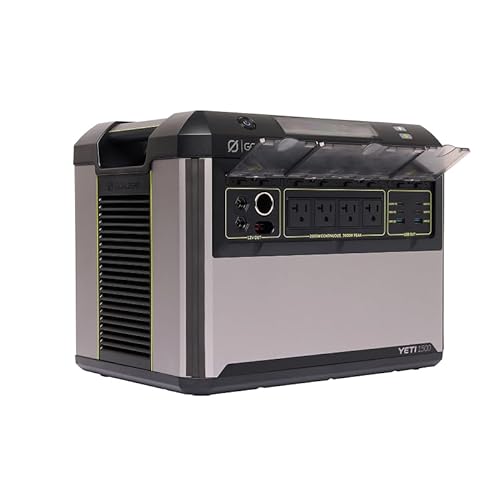
Brand Overview: Jackery vs Goal Zero Philosophy
Jackery
Jackery entered the market in 2012 with a focus on compact, user-friendly portable power stations. The Explorer line (especially the Explorer 240, 500, 1000, and 2000) has become the default recommendation for campers who want a balance of weight, capacity, and plug-and-play simplicity. Jackery uses standard lithium-ion NMC cells in most models, though newer Pro and Plus series units have switched to LiFePO4 chemistry for longer cycle life. The brand emphasizes fast AC charging, a clean mobile app, and a growing ecosystem of foldable SolarSaga panels.
Goal Zero
Goal Zero started in 2009 with a humanitarian mission and built a reputation on rugged, modular systems. The Yeti line (including the Yeti 400, 1000, and 3000) uses a mix of lithium-ion and LiFePO4 depending on the generation. Goal Zero differentiates with the Expansion Tank system, chaining capability, and a wide range of accessories like the Yeti Link vehicle integration kit and Nomad solar panels. The brand targets serious off-grid users, overlanders, and backup power buyers who need serviceable, expandable hardware.
Jackery vs Goal Zero: Price Comparison
Price is often the first filter. Jackery generally sits lower on the cost-per-watt-hour scale, especially at the entry and mid tiers. Goal Zero commands a premium for modularity, build quality, and North American support infrastructure. The table below compares the base units only. Solar panels and expansion batteries add significantly to total cost of ownership.
| Model | Battery Capacity (Wh) | Battery Chemistry | Continuous Inverter (W) | Peak Surge (W) | Weight (lbs) |
|---|---|---|---|---|---|
| Jackery Explorer 240 | 240 | NMC | 200 | 400 | 6.6 |
| Goal Zero Yeti 400 | 396 | NMC | 300 | 600 | 17 |
| Jackery Explorer 500 | 518 | NMC | 500 | 1000 | 13.3 |
| Jackery Explorer 1000 | 1002 | NMC | 1000 | 2000 | 22 |
| Goal Zero Yeti 1000 Core | 983 | NMC | 1200 | 2400 | 31.7 |
| Jackery Explorer 2000 Plus | 2042 | LiFePO4 | 3000 | 6000 | 61.5 |
| Goal Zero Yeti 3000X | 2982 | NMC | 2000 | 3500 | 69.7 |
Key takeaway: Jackery delivers more watt-hours per dollar at the 500 Wh and 1000 Wh tiers. Goal Zero closes the gap at the high end where expandability and serviceability matter more than raw capacity per dollar.
Performance Deep Dive
Battery Capacity and Real-World Runtime
Rated watt-hours only tell part of the story. Inverter efficiency, self-drain, and temperature all affect real-world runtime.
Solar Charging Speed and Panel Efficiency
Solar panel efficiency and charging speed are where the Jackery vs Goal Zero comparison gets practical. Jackery SolarSaga 100 panels rate at 23.7% cell efficiency. Goal Zero Nomad 100 panels rate at 21.5%.
Both brands support pass-through charging. Jackery max solar input on the Explorer 1000 is 126 W (two 100 W panels in parallel). The Yeti 1000 Core accepts up to 600 W via the high-power port (HPP) with the Yeti Link or four Nomad 100s in series-parallel. For large arrays, Goal Zero scales better. For grab-and-go simplicity, Jackery wins.
Inverter Wattage and Device Compatibility
Every model in both lines uses a pure sine wave inverter. That means safe operation for sensitive electronics: CPAP machines, laptops, drone chargers, medical devices. The continuous and peak ratings differ. The Jackery Explorer 1000 offers 1000 W continuous, 2000 W peak. The Goal Zero Yeti 1000 Core offers 1200 W continuous, 2400 W peak. On paper Goal Zero wins.
USB-C Power Delivery is standard on all current models. Jackery tops at 100 W PD on the Explorer 2000 Plus. Goal Zero maxes at 60 W PD on the Yeti 1000 Core and 100 W on the Yeti 3000X. If you fast-charge a MacBook Pro or power a USB-C monitor, Jackery has the edge.
Battery Chemistry and Degradation Over Time
Lithium-ion battery degradation over time is the hidden cost. Standard NMC cells (used in Explorer 240, 500, 1000 and Yeti 400, 1000 Core, 3000X) typically retain 80% capacity after 500 cycles to 100% depth of discharge. LiFePO4 cells (Explorer 2000 Plus, newer Yeti Pro models) retain 80% after 3,000 cycles. That translates to roughly 3 to 5 years of weekly camping for NMC versus 10 or more years for LiFePO4.
Storage discipline matters most. Storing at 50% charge in cool conditions extends life for both chemistries. For reference on lithium-ion storage best practices, see the U.S. Department of Energy guidelines on battery storage.
Noise Levels and Fan Operation
Fan noise matters in a tent or van. Check each manufacturer’s published noise rating for the specific model before buying.
Temperature Performance
Operating temperature range affects winter camping and desert use. Jackery rates -10°C to 40°C (14°F to 104°F) for discharge, 0°C to 40°C for charge. Goal Zero rates -4°F to 104°F for discharge, 32°F to 104°F for charge. Both work in freezing temps if you keep the unit insulated. Charging below freezing is blocked by BMS on both brands. Warm the unit first.
Ecosystem and Expandability
Expansion Battery Packs
Expandable power systems and modularity are a major differentiator in the Jackery vs Goal Zero debate. Jackery Battery Expansion packs (1000 Wh, 2000 Wh) connect via a proprietary cable to the Explorer 2000 Plus and 3000 Pro. You can stack up to 12 kWh total. The connection is plug-and-play, auto-detected in the app, and adds zero complexity.
Goal Zero Expansion Tank uses a high-current bus connector on the Yeti 1000 Core, 1500X, and 3000X. Each Tank adds 2.4 kWh (LiFePO4) or 4.8 kWh (NMC). Up to 4 Tanks can chain. The system is more industrial with bolts, cables, and a separate BMS module. It suits fixed off-grid cabins or overland rigs where the stack stays mounted.
Solar Panel Ecosystem
Jackery SolarSaga panels are lightweight, foldable, and use magnetic closures. The 100 W and 200 W models pair directly with Explorer ports. No adapters needed. Goal Zero Nomad panels are heavier, use canvas backing, and connect via 8mm or HPP connectors. Goal Zero also offers the Boulder series, rigid panels for roof installs. If you want portable foldables, Jackery is lighter. If you want permanent roof arrays, Goal Zero Boulder integrates with Yeti Link for vehicle alternator charging.
Mobile App and Software Support
The Jackery app provides real-time load monitoring, solar input tracking, and estimated runtime. Updates roll out monthly. Goal Zero’s Yeti app offers similar features but with slower update cadence. Both support firmware updates via USB or WiFi. For van lifers who obsess over battery state, Jackery’s app transparency wins. For occasional users, the difference is negligible.
Warranty and Customer Support
Jackery offers a 2-year limited warranty on all Explorer models with free shipping on repairs within North America. Goal Zero offers 1 year on NMC models, 3 years on newer LiFePO4 Yetis. Goal Zero’s US-based support team is known for responsiveness, and the brand maintains a stronger network of authorized service centers. Jackery support is improving but lags on phone availability. For critical systems, Goal Zero’s warranty advantage matters.
Which Brand for Your Use Case?
Choose Jackery if you:
- Want the best price-to-capacity ratio for weekend camping trips
- Prioritize portability and weight over expandability
- Plan to use solar panels frequently and want fast charging
- Value a clean app and intuitive controls
- Run mostly USB and AC loads under 1500 W
- Prefer newer LiFePO4 chemistry on higher-end models
Choose Goal Zero if you:
- Are building a permanent or semi-permanent off-grid system
- Need industrial-grade modularity and expansion capacity
- Want vehicle integration (alternator charging via Yeti Link)
- Require higher continuous inverter wattage for power tools
- Value North American customer support and local service centers
- Plan to keep the system for 5+ years and prioritize durability
Frequently Asked Questions
Can I mix Jackery and Goal Zero solar panels?
No. Jackery uses proprietary 5.5 mm connectors, while Goal Zero uses 8mm or HPP. Adapters exist but reduce efficiency. Stick with the brand’s ecosystem.
Which battery lasts longer, Jackery or Goal Zero?
LiFePO4 models from both brands last 3 to 5 times longer than NMC. The Jackery Explorer 2000 Plus (LiFePO4) will outlast an NMC Yeti 1000 Core by approximately 7 years under typical use.
Is it worth buying used Jackery vs Goal Zero?
Used NMC units (older Explorer 1000, Yeti 1000 Core) are risky. Battery capacity degrades unseen. Look for certified refurbished units with warranty. LiFePO4 models hold value better.
Do I need both AC and solar charging?
For van life or off-grid cabins, yes. AC charging (home outlet, RV 30A) tops up fast. Solar sustains daily loads. Both brands support dual charging simultaneously.
Can either power an RV air conditioner?
No. A typical RV AC pulls 3,000 to 4,000 W. Both brands max at 3,000 W (Jackery 2000 Plus). You’d need 5 kWh+ and multiple battery banks chained. Not practical for mobile use.
Final Verdict: Jackery vs Goal Zero
There’s no single winner. Jackery delivers better value for casual campers, weight-conscious van lifers, and anyone starting out. The ecosystem is simpler, prices are lower, and newer LiFePO4 models are genuinely competitive on durability. Goal Zero wins for serious overlanders, off-grid homeowners, and anyone who plans to expand or service their system long-term. The modular Expansion Tank approach scales to 10+ kWh. North American support is stronger. If you’re torn, buy based on your primary use case: portable weekends (Jackery) or permanent/semi-permanent power (Goal Zero). Both will reliably power your adventures.
Next steps: Compare the exact models you’re considering side-by-side using the specs table above. Factor in solar panels and any expansion packs you anticipate. Budget for batteries to last 3 to 5 years minimum, then decide if you want to upgrade or add capacity later. That calculation often tips the scales.
